Friday, November 21, 2014

Fleas vs. Cuddle time

My desire to love all the street dogs is constantly battling my equally strong desire to not get, and consequently give, my family fleas (among other diseases).

*Side note: I know it’s been a while since I posted...and I feel like this might be a regular thing, although I would like to try and stick to a “at-least-once-every-two-weeks schedule”. We’ll see if I’m able to stick to that; I also keep a hand-written diary/journal, and so when I’m behind on that, plus this, and then I write that, I find I have little interest in recounting the same things here.  I will try my best to keep this blog updated, as I know I have millions upon millions of readers interested in knowing what’s happening in my life here in Macedonia.*

Something I’ve wanted to share for a while has been about the dogs and puppies that roam the streets here. There are quite a few stray dogs roaming the streets, and my American heart is sensitive to seeing their plight.  I’m having a hard time with it as an animal lover.  The treatment of animals in general here is one of my self-identified cultural challenges I’m facing.


Some cultural background:

Owning dogs here isn’t that common, yet it’s becoming more common in the cities and mostly among ethnic Macedonians, and very rarely among ethnic Albanians.  In Islam, dogs are considered dirty, and animals aren’t seen as pets, but rather what they are: animals.  Animals don’t live inside, they live outside.  I found out recently that my current family “had” a cat for twelve years! It never came inside and they just fed it their extra food...for twelve years. Naturally (from an American perspective), my interest was piqued and I asked them, 

“Aww! What was its name?”  

“It didn’t have a name.”

“Ummm....what? What do you mean?! What did you call it?!”

“Cat.”

I met this cat in Glodji and named him 1.2 minutes later. His name is "Miku" which means "Friend" in Albanian. He's SO nice and just looking at him causes him to purr. His best assets are his cuddliness, cleanliness, and lack of fleas. I hope he is still at my future site when I move there in a couple weeks.


My wise father pointed out that giving animals names definitely humanizes them and that’s just not a common practice in my Muslim, Albanian village. It’s strange to me because every stray that I meet I’ve given a name. My family thinks I’m insane and worries for my safety constantly; they definitely believe that all the “wild” dogs here are very evil and will bite you. 


O contraire!

Scrappy. So happy, so hopeful, so friendly.
Bonnie (another PCV) and I are the major dog lovers in our group here and so we’ve pet, like, all the dogs. None of them are clean, most aren’t that dirty, and all of them are THE NICEST DOGS EVER. Our families really don’t believe us and they are terrified of the dogs here–irrationally terrified.  The main reason they don’t like us girls going out after dark is because the dogs are out and will bite us. We’ve tried telling them how nice they are, and after a little over two months here, I think they’re getting the message...not that their fears have lessened for themselves. It’s a start.

The highlight of the stray dogs here have been the adorable puppies that had moved in next to our school and stayed there for about three-four weeks.  We named them: Storm (he has mutant toes and Storm is a mutant from X-men), Lulëstrydhë (strawberry in Albanian, “Lule” for short, which means flower), Tia (the runt of the litter), Chunk (after Chunk from the Goonies, he’s the biggest), and Polo (he was always wandering, so his name came from Marco Polo).  The mom’s name is Lili and she’s very very sweet. I love them all and couldn’t get enough of them. Except I never held them close to me, always rolled up my sleeves, and vigorously scrubbed my hands and forearms afterwards (yes, I’m aware that fleas jump 20 ft. or so, but they also don’t leave their host very often...so, silver lining!). Someone in the community also likes them because they built this really cute little shelter next to the school so they could get out of the rain.


Please enjoy this video about some of the dogs (mainly puppies) in Dobroshte that I made.  It contains much better quality and content and waaayyyy more cuteness than my previous cow sacrifice video. Waayyyy cuter. At one point around the 0:40 mark, there's a horrifyingly cute moment where ALL the puppies start scratching themselves at once...so...many...insects all over them. 


It was hard sometimes when we were in our language classes, because children would get out of school and “play” with the puppies. We don’t always know what they did to them, but we would occasionally hear the puppies yelping and it would just break our hearts.  We yelled at them as best as we could in Albanian, and it always came out as “No! They are puppies. They are babies. Be careful! No *motion throwing rocks, point at sticks*. No. No.” The children got better with the pups and after watching them play and “yelling” at them, we came to see that their intentions were generally good but sometimes a little misguided. Through example we were able to model how to appropriately play with the dogs.


SAD NEWS ALERT! Don't read if you are happy and want to stay that way.


No seriously, it's sad.


I did warn you. Just sayin'.


Unfortunately it breaks my heart to report that after we had our site visits to our future families for three days, we came back and there were only two puppies left: Polo and Lulë.  We talked to some local kids and one girl told us that one was hit by a car, one drowned in the ditch, and they don’t know about the other one...he “probably drowned too”.  This is why you should never love things. My roomie Anne Fox tried to explain this to me for many years, and I never listened. 


To end on a happy note: I've been flea- and insect-free the whole time here (knock on wood)! 

 Moral of the story: pet all the dogs and cats, just don't let them touch your clothes and wash your hands afterwards.


Thursday, October 23, 2014

Contacting me: Address and emergencies

Wanna send me a package? Or better yet, a letter?

Here's what ya gotta do.

If you want to send me anything, please email me, contact me on Facebook, or ask my parents. I know, sorry for not writing my address. This is a public blog after all, and our Safety and Security manager, Goce, would criticize me for not being vigilant...but I'll give it out privately.

Packages
       It's very important that you don't claim a lot of value if you send a package (it's expensive,  to send, so just be warned), please DON'T put any more than $15-$20.  The customs fees for me are so expensive if it's more.  If you do send new items, just make sure to take the tags off of them and claim them as old items.  So there you have it. I don't know how people get mail in my tiny village of Pershevcë as there aren't street signs or house numbers.  I think the town is just small enough that the mailman knows where everyone lives, but I'm not quite sure.

Other ways to contact me include Facebook, iMessage, Whatsapp, Viber, and email. I'm pretty connected to the internet here--which is both good and bad. If you would like my phone numbers or email or anything, please find me on Facebook and private message me. My iMessage and Whatsapp are the same number as before, my Viber is my Macedonian number (this number can also be given out privately, if you so desire it).

Emergency
This next part is mainly for family, but in case of an emergency: 

Peace Corps headquarters toll-free number: 855-855-1961

Press 1 for <Counseling and Outreach Unit> 
(family emergencies; to get information to a volunteer overseas.) Available 24 hours
Extension number: 1470
(Direct phone number: 202-692-1470)

The people at this number will get any information you need to relay to me to the people who need to know, who will then be able to contact me/get me home if need be.  Even if you've contacted me through a different medium, this is still a good number to have.


Sunday, October 12, 2014

Kurban Bajram


     Kurban Bajram or Eid al-adha can be translated as “Feast of the Sacrifice” is a major Muslim holiday.  It honors Abraham who promised to sacrifice his son Ishmael to God, before God intervened and gave him a lamb to sacrifice instead.  In honor of this sacrifice, many families here will sacrifice an animal.  In my village there are more cows sacrificed, yet some sheep were sacrificed. It fell on Saturday, October 4th this year. 

For Dobroshtë and my Albanian Muslim family leading up to that Saturday there was much anticipation and preparation. So much cleaning took place! My whole family and I pitched in to help with various chores in the few days leading up to the holiday, but most of it was done by my incredible and hard-working host sister, Amire.  She cleaned the house top to bottom--everything from windows to walls to carpets.  I figured out why the carpets here are just laid across the floors and not “installed” in a typical sense like we would think; the carpets are hand-washed, outside, with the hose.  Amire rolled up one of the main carpets and placed it outside, sprinkled it with laundry detergent, sprayed it with the hose, hand scrubbed it with a little broom-cleaner-thing, then washed it out with the hose, and hung it up to dry.  It was a very labor-intensive process and I respect her for doing all that hard work.  
She's fantastic.


Additionally all the floors were vacuumed--the kitchen-area carpet was maybe vacuumed 6 times, by just about every individual in the house in the day leading up to- and the day of Bajram.  We also scrubbed the kitchen chairs with a whole lotta dish soap and a sponge. The curtains were washed, the linens taken down from drying, and the Baklava was made. We were ready.

I went into it not knowing exactly what to expect except (say that ten times fast) lots of small misafiri (visits) and food. 

Breakfast of champions.
We started out at 8:00 am, after the men got back from something that happened at the mosque that started at 6:00 am, eating breakfast.  This breakfast is a large breakfast with warm, cooked food...and it’s the one of two days throughout the year that they don’t drink çaj rusi (russian tea), but rather Turkish kafe.  With barely enough time to finish our meal of soup, rice, chicken, potatoes, cabbage salad and vegetables, the misafirs started to come.  My family gave me the task of offering a bowl of candy to our guests--I wanted to help, plus everyone thought it was cute that “The American” was helping.  

Homemade--another blog post will be dedicated to just this delicious pastry.

The visits really did only last 5-15 minutes, and most were made by men, because the women stay at home preparing the drinks and serving the baklava; every house had baklava.  When we started going out and making our rounds to different homes, I was quickly eating my way to diabetes with all the sugary, syrupy baklava.  Don’t get me wrong, it was delicious, but oh dear lord the sugar.  Thank goodness I drink my tea without sugar.


A misafir--I spoke German to the man next to my host dad. I've been able to use my German a lot as a lot of people here can speak German, and sometimes assume, based on my appearance, that I am German.  He smokes, and even though there's no smoking in our home (he told me "Hier, rauchen ist verboten!"), he still lit up. I was perplexed by this behavior, but it seemed like what used to happen in the US when smoking was more widespread.

Albanian siblings! (Samed, Azra, Unë, Amire)
A cousin in traditional bridal clothes. 

Another new bride in a different, traditional Albanian style bridal gown.
New brides will wear their wedding dresses for up to a year after
getting married when they have visitors over.

This is the more traditional dress that we're used to in
the US that she would've worn for the actual ceremony. 


**Warning: "graphic" descriptions and a short video of sacrificed cows**


     The highlight of my day by far would be that I got to witness them sacrificing a cow.  We happened to arrive at their cousin’s home where there was already one small-looking cow that they had already killed and were skinning and starting to get it ready to get its meat.  A few things stood out: 

          –They cut the neck really deep to kill the animal, I assume for a faster death. Looking at the cow it was cut basically through everything and that just surprised me.

          –It is something they are definitely accustomed to here in the village and I don’t think they often kill their cows for meat, and they are more for producing milk.  However there were a few children helping, watching, or just being in the vicinity. 

          –The men seemed to be expertly skinning the animal.  It completely reminded me of when we skinned our cats in biology class--almost exactly.  I think because of my biology exposure to dead animals (even though they were way smaller) and having lived with a veterinarian roommate for 4 years, this didn’t gross me out.

          –The only part that did kinda give me the heebie-jeebies was when they started snapping off the legs at the knee joint.

     Then the “REAL” cultural experience took place as I was able to witness the entire process of a cow sacrifice.  If you don't want to watch the video (which took me a really long time to put together, so you better watch it), here’s what happened: 
  1. Tie the cow’s head to a tractor, march it out onto the designated spot.
  2. Tie more ropes around it and then get it to lie down on its side.
  3. Keep the cow calm and on its side, hold your part of the rope fast if she kicks out or moves.
  4. Talk in a lot of Albanian about things and then keep talking, making the American wonder what is going on and why this is taking so long.
  5. Get the knife that was hiding and quickly cut the cow’s throat.
  6. Scoop up the blood with a shovel into the nearby, 3 foot hole that was dug for to put things into.
  7. Wait for the animal to die.
  8. Be surprised when you think it’s over and then a final burst of energy happens, and then it’s really over.
  9. It lasted about 15 minutes.


VIDEO

It is "graphic" but because I was filming from the posterior of the cow, and at a little bit of a distance, you don't actually see any of the actual slicing and dicing of the live animal.  There is a dead cow that you see being prepared, and it isn't much more than you would see in a butcher store...but the context is a little different. I really did work on it for a while, so I hope you enjoy it!


The Udder
A short essay

     It was surprisingly not that emotional for me to watch, and I think that was mainly due to the fact that I couldn’t exactly see the lifeblood draining from the cow.  It was all a very peaceful experience and I’m very grateful that the cow wasn’t crying out or struggling, which would’ve made it a lot more emotionally hard to handle.  The whole event was much more peaceful than I had anticipated, and was also a lot less formal than I thought it would be. It was also done as humanely as anything of that nature could be done, it was performed in the name of God, and it will feed many people with little waste--any extras get thrown into the “blood hole” in the ground.  

     The one thought I couldn't get out of my head the whole time was, "What are they going to do with the udder?" I couldn't get it out of my mind, and that was mostly because it was clearly full. Some milk even spilled out onto her leg and I couldn't stop thinking of it.  I couldn't stop thinking of the symbolism of the milk that brings life, and the sacrifice that I was witnessing.  Did they drink the milk? Did they discard it? How long does it take for milk to go bad in that kind of situation? What about the actual udder? 

     By the time we left and were walking home, I was just trying to process it all. I was thinking about why I wasn't upset, thinking maybe I was in shock, thinking of possible things they did with the udder, feeling exhausted from worrying about the cow, and mostly just wondering about the udder.  Once I actually thought of voicing my udder-related questions out loud, it seemed too weird to bring up, and I feared that I wouldn't like the answer.  So I still don't know what happened to that udder, and maybe some day I will.  I kinda like the fact that it's a little shrouded in mystery.


Friday, October 3, 2014

Familja Shqiptare


I am loving it here in Macedonia, and that’s in large part due to my amazing host family.  They are so kind, loving, and open.  I have been accepted in their home from day one as another member of their family.  Literally, one of the first things communicated between the parents and me was “Now you’re one of us!” Except there was a lot less English, more Shqip (Albanian, pronounced: sh-ch-eep), and lots of hand gestures and blank stares from me.  This is still how most of our communication is done, with a few personal pronouns, “dua” or “kam” (want, have), and various common nouns thrown into the mix.

Në shtepi/home


For my PST (Pre-Service Training) site, I’m in Dobroshtë/доброште (about 20 minutes from Tetovo where we had our orientation week) and I will be here until the day after Thanksgiving, when I’ll be moved to my permanent site for the next two years.  Dobroshtë is a mixed community of 97% Albanians, and 3% Macedonians, with a population of about 3.000 (their comma use is flipped with periods).  It’s definitely a small town and the two ethnic communities’ sides of the town are divided by a bridge--oh the symbolism.  The Macedonians are predominantly Christian Orthodox and the Albanians are predominantly Muslims.  I see some similarities in their tensions/divisions with each other and the ones we have in America between White and Black Americans and Americans and Latinos.  Not the same, and I don’t know enough about the conflict here, except that in 2001 Peace Corps had to be evacuated because fighting between the 2 groups broke out and a mini-“war” ensued; about 200 people died and about 35 of the deaths happened here...or so rumor has it.  I’m sure I will here more about this and when it comes to any sort of Macedonian political matters, PCVs are neutral and not allowed to express an opinion as we are literally here for peace and to help the locals.
Our ideal of the bridge, which we have named "The Friendship Bridge"


_______________________________

I live with a Muslim, Albanian family/Familija Shqiptare.  I have a mom and dad (Imerzatë and Qemal)--about my parents’ age--and three siblings: Amire (34), Samed (28), and Azra (22).  They have another 36 year old sister who’s married and living in Denmark.  My siblings all speak varying levels of English and we haven’t really had any problems communicating.  I’m definitely another motra/sister and I’m already really close with Amire and Azra.  Qemal (pronouned chay-mall) is probably the smiliest man I have ever met, and when he smiles his whole face becomes one giant wrinkle that make his eyes all but disappear.  Imerzatë is incredibly sweet and is constantly worried about how cold I am; she can’t believe I walk around in a t-shirt with no socks on, when she has 3 layers of sleeves on because she’s always cold.  She also loves salt and puts it on everything--Mom, sound familiar? The whole Maksuti family is incredible and I can’t wait to spend the next three months with them! 

Nëna/Mom 

Baba/Dad

Kjo quhet Azra. Ajo është motra shqiptare ime.
Kjo quhet Amire.  Ajo është motra shqiptare ime gjithashtu.

Funny moments me familija ime:


**This was literally my first moment in my new home.  Amire had come pick me up and brought me back home to meet the family.  I knew all about the kisses on the cheeks as a standard greeting between women; I’ve greeted people like this in Spain, Kuwait, France, and various other locations.  The only difference between those kisses and the ones here is the very simple fact that I’ve always gone right first...and here they go left.  So as I went in to greet my new host-mom (the very first person I greeted), we both went the same way, then awkwardly  and nervously tried to accommodate the other--all while in continuous motions towards one another.  You can imagine what happened: I kissed my host-mom. Full on. Right on the lips.  

Oh the embarrassment. 

Thankfully, and for some reason unbeknownst to me, my family has never brought it up, yet it garnered plenty of laughter in those first few awkward moments.


**Winter is coming. 

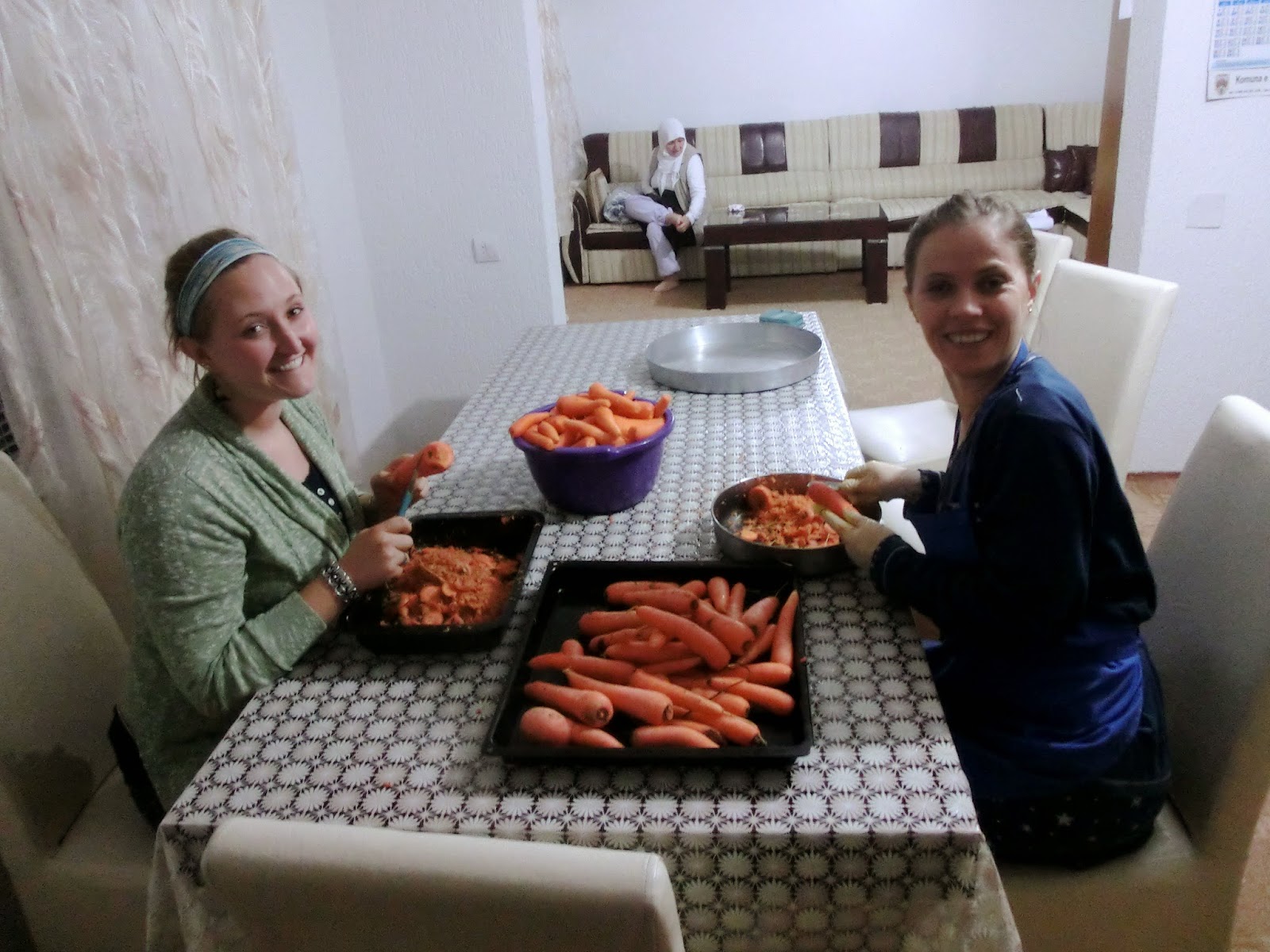
No one gets this reference, but we say it all the time now because we’re actually preparing for the coming winter.  Amire, Samed, and I chopped about 23 kilos of cucumbers and 23 kilos of carrots--it took us about 3.5 hours.  It was really fun because we all bonded and laughed the whole time about one thing or another.  Our humor translates really well, which is nice.  
Winter is coming.

Sister bonding. When you peel the carrots there is so much water that splashes on your face, so we decided instead of avoiding the splash back, that we'd get it on our faces because it's a natural juice and probably good for you.

So many carrots. So. Much. Chopping.

We got tired of all the cucumbers...after chopping one carrot, we missed the cucumbers.  They are so soft and sliceable, ya know?

So we’re busy chopping, peeling, and washing vegetables when Azra comes downstairs from studying (she has her final exams to graduate college with a major in Pharmaceuticals) and in English she exclaims: 

“Wow! Samed! You’re actually working. Stacie, he never works or does anything around here.” 

To which Samed rolls his eyes and tells me, “Azra is a liar.”

I respond, “Well, looks to me like he’s doing all the work and you’re doing nothing.” 

That was the time I received my first fist bump from Samed and high fives were to be had all around.  Tears from laughing ensued.  Sass translates very well.

Samed and I were chopping buddies. 

Winter is coming, but we are ready.

Ready for winter.


**Eating dinner with the family one night, there was raw pepper from the garden on the table (a common occurence...yum!), and Qemal took a piece of the spec and said something and made a gesture towards his face.  Azra told me he said:

“Here we say that if you eat a lot of peppers, it will make you beautiful.”

Without missing a beat I replied, “Oh, I don’t need peppers.”

Seriously, sass translates well.


Thursday, September 25, 2014

Surface differences


View of my street in my PST community of Dobroshtë.


This post is going to be about all the surface-level differences I've personally seen or experienced in my PST community of Dobroshtë.  Many of these differences apply to most Albanians living here, but just remember that all families are different and my situation isn't always the same as everyone else's.  I'm sure I will notice way more once I become more integrated and comfortable with my family and with the town.  For now, enjoy these 8 differences.

  1. Toilet paper. Toilet paper is disposed of in the trash can, so as not to clog the septic system.  This is why the trashcans have lids on them, otherwise it could become very smelly, very fast.  Now this issue of toilet paper disposal is only an issue if the family even uses toilet paper.  A volunteer in an Albanian village told us to bring some toilet paper with us, as there might not be some in our homes.  I told her I didn’t mind, as I got used to bidets and washing with water when I lived in Kuwait.  That’s not the case, however, and there typically isn’t even water available.  I can only assume that they wipe with their hands or don’t wipe at all...I’m not quite sure.  All I know is that there wasn’t any TP in my family’s home, but after the first day they put up a holder, and the second day they added TP to it.  Luckily our toilet was next to the bathtub and the shower head is attached to a hose...so it wasn’t an issue for me.  If I DID use the toilet paper, though, I would have to carry it, soiled, to the “trash can” (plastic bag) in my room...and that just seems unpleasant.  All that’s left to figure out is how to dry off afterwards, or if I just pull up my pants with butt water still on them.  Time will tell what I choose to do.
    Notice how there's no curtain or place to put the shower head. I try not splash water outside the tub, but it seems the my host siblings get water EVERYWHERE when they shower.
  2. Gardens. Everyone here seems to have a garden.  The food we eat is pulled off the plants or dug up from the ground mere minutes before eating it.  My family has carrots, peppers, tomatoes, potatoes, onions, parsley, kiwis (yes, they grow here but won’t be ready until around November), figs, and apples.  I had never had a fresh, non-sugar coated fig before and they are absolutely delicious.  A lot of families have grapes and they are hands down the most delicious grapes I’ve ever eaten.  If I had grown up eating these tomatoes, I would’ve actually grown up eating them (they grossed me out up until about 6 years ago).  Part of the reason for all the food from the garden is because salaries here are low and in order to get by, people need the extra food or revenue (if they sell their produce).
    Our beautiful garden.
    Fresh-from-the-vine fig.
  3. Çaj/Kafe. At all times of the day--during, before, after, and in between meals--we are drinking tea or coffee. I don’t drink coffee (I told them I was allergic), and so I just drink tea; I don’t know if the family normally does this or not, but I haven’t seen them drink any coffee since being here, they’ve only had tea.  I am SO glad that I forced myself to like tea. So. So. Happy.  [Yet another reason to eat/drink things until you like them. You never know when it’s culturally gonna come in handy.]  I think I will drink more tea in my first week here than I have in my entire life. In their tea, though, they put a TON of sugar. So much sugar. The first tea they made me (given to me in the same small glasses that they use in Kuwait) was so incredibly sweet, and I was glad to know it was just added sugar and not how the tea itself actually tasted.  Now I drink my tea without sugar, and they just don’t understand how I like it like that. I tell them it’s healthier and you can really taste the çaj [chai].  My host sister Amire even tried it with no sugar; no one believed her when she told them the next day because she has a major sweet tooth. 
    It's in little tea glasses just like in Kuwait.
  4. Children. I see children all the time running around without supervision.  I know Americans can be overprotective of their children, but I’m talking about 3-5 year olds (mostly boys) just running around in packs and playing in the streets.  I don’t know how to feel about this just yet, and I don’t feel negatively about it, just a little surprised to see this. Plus I know I’m in a village so that could have something to do with it.  However I did see this at night in the neighboring (decently big) city of Tetovo, so it seems to just be part of the culture here.  I’ve been told that leaving children unsupervised happens in classrooms as well.
    What a great photobomb by Larry, a fellow PCT.
  5. Çaj/Kafe. No, seriously. You don’t understand how much tea I’ve been offered and drank already...and it’s barely been a week.
  6. Bukë. I will not only be consuming massive amounts of tea, but also massive amounts of (white) bread--though it is from a bakery.  With each meal I try and eat about 2-3 slices of bread.  I will put other foods on the bread or dip it in the main dish; if I don’t constantly have bread in my hand, mouth, or next to my plate, they seem to feel as though I’m starving myself and that must be encouraged to keep my will to live...so in reality I’ve probably eaten about 3-5 slices each meal to appease my host mother and father.  I’m sure I’ll find the right stew to bread ratio and eat the bread slower so as not to cause alarm. **Shout out to Deutschland for hands down having the best bread of any country I’ve visited thus far.**
  7. Home decoration. The way the Albanians decorate their homes is very minimal.  Almost nothing is on their walls, very few pictures are out, and it just seems a little unfinished.  Carpet isn't installed the same as it is in the US: it's more just laid over floors and it sticks up in corners and on walls. I don't know if this is just my house or not, but most of the rooms just have lights without light fixtures and things just seem unfinished.  I'm still trying to get a feeling for how well off my family is or not, but I've talked to some of the other PCT's (Peace Corps Trainees) and they also say their homes also have a sense of being unfinished.  To sum it up, they just just aren't decorated.
    My awesome host sister Amire in the living room.

    Like an extra room for the fridge, freezer, some wardrobes, and washing machine.

    Do you see the pot stacked on the other pot? That's where the tea lives.

    My room.
  8. Language. It’s hard to understand people here. It’s like they’re speaking another language or something.
    Host mom, Imërzat (I think that's how you spell it). She's so sweet and doesn't speak a lick of
    English...and we seem to have taken different charades courses, so it's hard to understand each other. It's getting easier, though.  Everyone keeps saying how crazy/funny she is, so I can't wait to actually start understand the little quips she keeps saying under her breath.

    Qemal [Chay-mall], my host father. The smiliest man ever. So kind, and quite funny. We like to communicate by laughing and pointing and not understanding each other.

Friday, September 19, 2014

Day 4-6; 17-19 Sept. 2014

If I manage to keep my water bottle through service training this week, it will be a miracle. I just keep leaving it everywhere.  Also, it’s something that identifies us as a foreigner and a behavior that confuses the Macedonians/Albanians here.

We did an intercultural training, and it was neat to learn about some cultural differences. I don’t want to give them away now, as I’m sure I’ll be blogging about them first hand when I start living with my family (I meet them on Saturday!). We’re all getting antsy and nervous about meeting our families...especially since all we know how to say in Macedonian is a simple greeting (hello, good day/morning/evening/night), I’m from America, I’m from America too, how are you, good/very good/fantastic, nice to meet you, good bye. Let me just say that with the intercultural training, they kept telling us to communicate with the families and tell them all these preferences about our schedule, foods we do/don’t like, when we take showers/go to bed, etc...and it all seems hard to navigate even if we were speaking English, as we are supposed to be indirect when making requests because being too direct is rude and we don’t want to offend anyone.

Since I’m placed in the dual language program, I am with an Albanian-speaking family (which is a language a lot like Basque and has unknown roots and is a branch of language all on its own, but thankfully uses the latin alphabet)...and we’ve learned all we’ve learned this week in Macedonian, in 2.5 hours today during Albanian-language training. Albanian (Schqip) is much harder than Macedonian, it seems.

I’m a little nervous about living in a Muslim community in terms of my freedoms and liberties I’ll have as a young, single woman.  We’ve talked about many of the restrictions we’ll have, and so I’m aware of what I’ll experience...yet what I’ll actually experience is something completely different. I want to try and jog a little bit, ride my bike, hike, and/or just go for walks...but even in a Macedonian community this is one of those “confusing American behaviors” and female athletes aren’t really a thing here. There are still volunteers who continue to be active and defy those cultural norms, and one (in an Albanian community) has even started a running club at her school and the kids really like it.  I don’t know what my type of activity or level of activity would be, but I’d like to do something.  I’ll just have to get my feel for my family, community, and level of safety; I’d also have to carry a stick or rocks to throw or threaten stray dogs with if I went out.


We’ll all be placed with our families tomorrow for our PST (pre-service training) sites.  We will only be staying there for 3 months and this is where we’ll get our training in language, culture, and procedures.  Four days a week, we’ll have 4.5 hours of language training--2 days Macedonian, 2 days Albanian.  There will be 9 of us living in Debroshte, a village of 4,500 which is just about 15 minutes outside of Tetovo (where we are now) and is about 90-95% Albanian.  Apparently the Albanians have more luxurious and larger homes, so the 4 of us who were assigned an Albanian family will probably have a very different Peace Corps experience than what is typically brought to mind when “Peace Corps” is mentioned.


Thursday, September 18, 2014

Day 3--17 Sept. 2014


Day 3--16 Sept. 2014

The place we’re in for orientation this week is super nice.  It’s called the Woodrow Wilson school and is an all-English school.  It’s on a compound and very isolated.  We’ve been reminded MANY times that this is absolutely NOT what our school work sites will look like. I feel like I’m in a hotel.


View from outside my dorm window
Woodrow Wilson School